(800) 626-1267

What Should An HOA Budget Template Have?

Every homeowners association relies on a carefully crafted budget for its yearly expenses. But, what does an HOA budget template look like? And what should it include?


What Is an HOA Budget Template? Why Is It Important?

Homeowners associations operate on an annual budget usually prepared by the HOA board or the budget committee. This budget serves as a guide that the board will use for the coming year’s expenses. Additionally, it is from this budget that homeowner dues are calculated.

It’s easy to say that an HOA budget is important. But, what exactly makes it so essential to a homeowners association?

First of all, the HOA budget has a direct impact on the association’s finances. Any board that uses a “go with the flow” approach to its expenses is destined to drive its HOA into financial ruin. The budget acts as your board’s guide — letting you know what you should spend money on and how much. This ensures that you don’t spend too much on a single line item and run out of money for other necessary expenses.

Secondly, the HOA budget allows you to determine how much to charge owners in dues. Without a template, you may end up charging too little or too much, which are both equally bad. Charging too little will put your association in a deficit and force you to levy special assessments. On the other hand, charging too much could tempt you into spending more money than necessary, simply because the funds are available.

A budget template also makes it easy for the board to plug in amounts for the expenses. This allows for a smoother and stress-free budget planning session for everyone involved.

Finally, the HOA budget template allows for transparency in your association. Homeowners have a right to know where their money is going, and the budget addresses that. In some states, the board is even required to present the budget to the membership for ratification. North Carolina, for instance, has such requirements for both HOAs and condominiums.


What Is Included in an HOA Budget Template?

You already know that the HOA budget plays a critical role in an association’s finances. Of course, there is a difference between saying you need a budget and actually preparing the budget. What should an HOA budget template even include anyway?


Expected Income

The first part of any HOA budget should cover the expected income or earnings of the association. This usually comes in the form of dues and assessments, though it can also include things like interest income.

If your association rents out its common facilities or amenities, income earned from rentals will fall under this section as well. Of course, it is not always possible to anticipate rental income for the coming year, unless it is a fixed event that happens annually.


Anticipated Expenses

The expenses portion of the HOA budget template is typically divided further into sections. There is no single correct way to prepare this part of the budget, as different HOAs may adopt varying styles. However, it is important to create an organized format that homeowners can easily interpret.

The following sections typically appear under the “expenses” portion of the HOA budget:

  • Administrative Expenses. This includes management fees, legal fees, bank charges, office supplies, the cost of preparing newsletters, and even reserve studies.
  • Maintenance Expenses. Line items under this section can include landscaping costs, cleaning services, maintenance supplies, electrical costs, plumbing costs, and the like.
  • Utilities. Under utilities, you have expenses such as gas, water, electricity, sewage, phone bills, and even trash collection costs.
  • Fixed Costs. This includes recurring costs that usually come at a fixed rate such as insurance premiums, property taxes, and annual report filing fees (Secretary of State).


Reserve Contributions

Lastly, every HOA budget should include reserve contributions. This is the amount the association should set aside in its reserve fund for future major repairs or replacements. The board must maintain the proper reserve level, which is usually 70 percent funding. To know how much is considered fully funded for your HOA, it is important to conduct a reserve study.


Sample HOA Budget

Make your budget planning season easier and less stressful with the help of the homeowners or condo association budget template below.
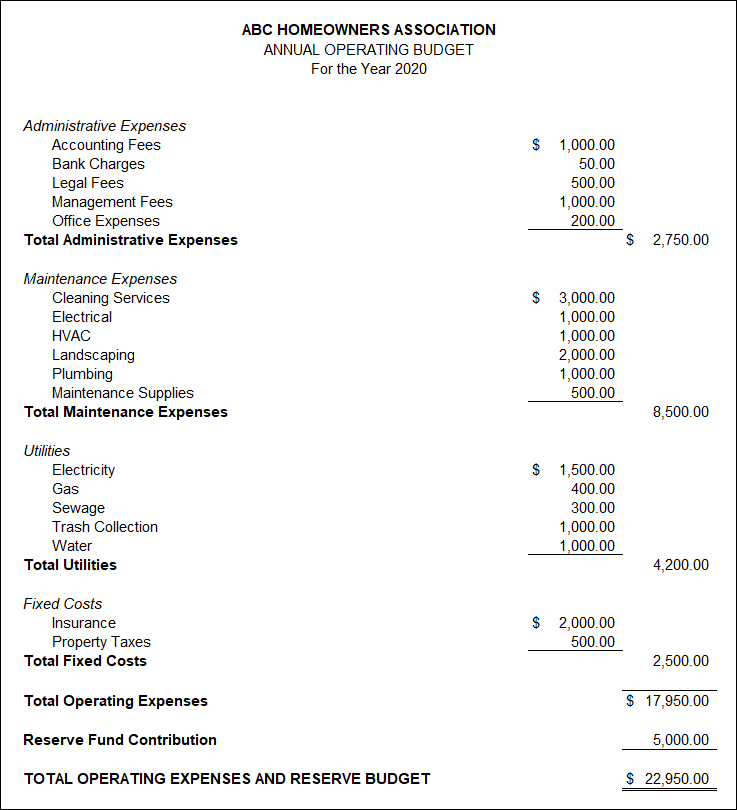
HOA Budget Template


Download Your HOA Budget Excel Template Here


Tips for Planning Your Next HOA Budget

Preparing an annual budget for your association can come as a challenge, especially if you don’t have a background in budgeting or have simply never done it before. As part of your HOA board, though, it is one of your duties to plan for the coming year’s expenses. Here are some tips you can use when drafting your next HOA budget.


1. Review Past Budgets and Reports

One of the best ways to ensure you’re on the right track is to look at past budgets and financial reports. When you do this, you can determine how much you spent on every line item in the previous years. This will give you an idea of how much you should expect to spend this year. Reviewing past reports is always a good place to start when you are planning your HOA budget.


2. Send Out RFPs

sample hoa budgetWhile it is good practice to review past budgets, they can only tell you what happened in previous years. But, things can change over time.

For instance, vendors can increase their rates or give special discounts. Before preparing your budget, it is a good idea to send out requests for proposals to vendors and suppliers. Doing this will allow you to gauge how much to allocate per service or expense.


3. Add a Buffer

This may seem like an obvious tip, but it still needs to be said. When planning your HOA budget template, don’t forget to add a buffer. Doing so will give you extra room in the budget to cushion unexpected costs or unforeseen increases. Of course, it is equally important not to go overboard with your buffer.


Easy HOA Budget Planning

The homeowners association budget preparation season can be a taxing period for HOA board members, but it doesn’t have to be that way. With an HOA budget template, you can easily input the expenses and amounts you expect for the year. From there, you can determine how much each homeowner has to pay in dues.

Of course, with Condo Manager’s HOA management software, budget planning is made even simpler. With a dedicated budget planning module, all you need to do is plug in the numbers and let the software do the rest. You can even export the budget as you see fit. Call us today at (800) 626-1267 or contact us online to set up a free demo.


RELATED ARTICLES:


HOA Account Delinquency Report: Does Your HOA Need One?

The HOA account delinquency report is an essential part of the financial reporting arsenal. Unfortunately, not all association boards know how to prepare this important report.


What Is an HOA Account Delinquency Report?

A delinquency report is a statement showing all of the delinquent accounts in a given homeowners association.

Let’s face it — nobody is perfect, and there are bound to be a few or more owners who fail to pay their dues on time. This can happen for any number of reasons, including financial struggles or simple negligence. It is the duty of homeowners to pay their dues on time. Similarly, it is the duty of the HOA board to make sure dues are collected.


Understanding How Unpaid Dues Affect the HOA

account delinquency reportDues and assessments are the lifeblood of every homeowners association. Without them, an HOA community would suffer detrimental consequences.

Remember that homeowners associations have the primary goal of maintaining the community to preserve property values. Maintenance, of course, comes with a price. There are many expenses an association must pay for, including but not limited to landscaping, cleaning, insurance, repairs, and professional management.

When an association falls short of dues, it is unable to cover these budgeted expenses. Faced with such a conundrum, most association boards will either turn to cost-cutting or levy special assessments. Both of these options are unfavorable to owners.

First of all, cost-cutting can be dangerous when done drastically. If there are a lot of delinquent accounts, the HOA will be forced to remove some major expenses or significantly cut back on them. This jeopardizes the quality of service.

Special assessments, on the other hand, are unfair to a lot of homeowners. While most boards have the power to impose assessments, delinquent owners usually fail to pay these as well. It leaves the burden of covering the deficit on the paying owners’ shoulders.


The Importance of an HOA Account Delinquency Report

It is easy to grasp how outstanding dues can negatively impact any homeowners association. But, where does the HOA account delinquency report come in?

As you might make out from its name, this report is specifically designed to track and monitor the delinquent accounts in your HOA. It gives boards a way to quickly determine how much owners owe to the association. With this information, you can make the necessary budget adjustments and decide whether or not to levy special assessments to meet your shortfall. It also makes it easier to identify who has unpaid dues so you can refer them to a collection agency if need be.


What Is Included in an HOA Delinquency Report?

The HOA delinquency report is rather simple in its format, but it shows everything you need to know about the delinquent accounts in your community. While it may change from one association to another, this report generally consists of the following:

  • Delinquent owner information (account number, lot or unit number, name, and address)
  • Amount of unpaid dues, typically divided according to age:
    • Current (unpaid dues below 30 days)
    • Over 30 days
    • Over 60 days
    • Beyond 90 days
  • Total unpaid dues per account
  • Grand total of unpaid dues per age

The report is similar to the HOA accounts payable report in that it shows aged unpaid balances. But, unlike the AP report, the HOA account delinquency report shows debts owed to the association. It also differs from the accounts receivable report. The AR report shows all outstanding invoices, whereas the delinquency report only shows debts in the form of unpaid dues by homeowners.


How an HOA Management Software Can Help

A delinquency assessment report is relatively easy to prepare by hand. But, as debts age and as owners settle their balances, it can become increasingly difficult to keep the report updated. Whether you are preparing or updating an HOA account delinquency report, management software can assist you in many ways.


1. Accuracy

One of the most common mistakes you can make when preparing a delinquency report is missing information. When you have inaccurate numbers or names, you can misattribute the unpaid dues and cause a larger issue. You might end up erroneously erasing someone’s debt or inadvertently adding to it.

Considering accuracy is the foundation of all financial reports, a faulty delinquency report can throw your entire operation into chaos. It will take more time and effort to retrace the numbers.

Thankfully, with the help of software, you can ensure accurate details. After entering all the necessary information (such as the dues amount, the deadline, etc.), the report will basically prepare itself.


2. Efficiency

Time-wise, it is inefficient to prepare your delinquency report manually, especially if you maintain a hard copy (or a single soft copy) of the report. This means only one person can update the report or has to literally pass it on to another board member. Transferring information from one report to another can also be a hassle.

When you use software, though, the entire process is reduced to simple clicks. You can easily tag an account as delinquent or for referral to a collection agency (if you use one). You can also update the report faster since it is largely automated. Beyond that, you can generate the report instantaneously whenever you need to. This allows any board member to gain access to the report, provided they have clearance or enter the correct password.


3. Confidentiality

 hoa delinquencyWhile it is required for some associations to share the total delinquency amount to homeowners, a majority are not allowed to disclose detailed information. In Nevada, for instance, the law prohibits associations from disclosing private homeowner information.
California, on the other hand, does not explicitly forbid publishing the names of delinquent owners, though doing so can be viewed as a violation of privacy according to Civil Code Section 5215. While some release such information to shame owners into settling their dues, experts agree that it is best for the association to refrain from employing such a tactic as it can result in liability.

Manually maintaining a delinquency report is a problem because it may accidentally end up in the wrong hands. But, with software, you can exercise more control over access and report generation. You can also choose to keep the program offline so that you can only gain entry from a specific location.


Get the Best for Your Homeowners Association

An HOA account delinquency report is definitely an integral accounting tool that every association should use. Preparing and maintaining it, though, can come as a challenge without automated assistance.

This is where Condo Manager comes in. Make accounting and financial reporting easier using our comprehensive management software. We have programs designed for self-managed communities as well as large-scale companies. Give us a call today at (800) 626-1267 to learn more information or contact us online for a free demo.


RELATED ARTICLES:


HOA Accounts Payable Report: What Is This For?

The HOA accounts payable report is an important tool for measuring an association’s debts. Unfortunately, not all board members fully understand how it works.


What Is an HOA Accounts Payable Report?

As with other organizations, a homeowners association operates with the help of a financial system. Homeowners pay monthly dues, which the association then uses to fund various expenses required to maintain the community. Not all of these expenses, though, are immediately paid when they are incurred. More often than not, vendors will perform the work and send a bill later on. Some require downpayments first, with the rest being due upon completion of the work.

These are accounts payable.

Any debts the association has to other parties are considered accounts payable. If your HOA owes money for landscaping services, your accounts payable increases. The same goes for when you owe money for construction work, maintenance and repairs, supplies, and the like.

An accounts payable report is a financial report that details your association’s debts. Basically, it contains all of your accounts payable or AP for the period.


What Is Included in a Homeowners Association Accounts Payable Report?

It is easy to get lost in a sea of financial data if you have no prior accounting experience. This is particularly true for the more complicated statements such as balance sheets and general ledgers. But, the accounts payable report is rather simple — certainly far easier to understand than a balance sheet.

The components of an HOA accounts payable report are as follows:

  • Vendor names
  • The amount your association owes to each vendor
  • How long you have owed the debts to each vendor
  • Whether any payments are past due

For the duration of the debts, you will typically encounter five columns separated by 30 days. The first column contains current debts, those that are under 30 days old. The second column is for debts that are 1 to 30 days past due, the third column for 31 to 60 days, the fourth column for 61 to 90 days, and the final column for debts that are over 90 days past due. Because debts age, the accounts payable report frequently changes, with debts moving from one column to another when they hit a certain point.


The Importance of an HOA Accounts Payable Report

Some HOA board members might wonder why preparing and maintaining an accounts payable report is even necessary. While it might not be for associations that use the cash basis of accounting, associations that use the accrual or modified accrual methods will greatly benefit from the report.

For one thing, an HOA accounts payable report will help you manage your debts. You can track how much you owe, how long you have owed them, and to whom you owe them. The report is organized in such a manner that you can visualize your debts at a glance.

Tracking your debts can help your associations in two ways:


1. Save Money

Firstly, it will reduce the occurrence of interest. When you pay your debts on time, it eliminates vendors charging you interest or late fees. This will save your association a lot of money in the long run. With this report, you can settle your debts when they become past due or pay those that have been past due for longer.


2. Maintain a Good Reputation

Secondly, tracking your debts will allow you to manage them better and maintain your reputation as a good payer. Nobody likes doing business with bad payers. And word can spread around relatively fast among vendors — even faster when you live in a small town. To maintain a good working relationship with vendors, you need to pay your debts on time. Again, the HOA accounts payable report can help you with this.


Accounts Payable Report vs Accounts Receivable Report

If you know anything about accounting, then you know the difference between accounts payable and accounts receivable. Accounts payable is what your association owes, while accounts receivable is what other parties owe to your association.

The accounts receivable report is basically the complete opposite of an accounts payable report. An AR report lists down all of the names of your debtors, how much they owe you, and how long they have been due. It provides you with a way to easily track your receivables.

Sometimes, associations will have a separate delinquency report from the AR report. The delinquency report consists of all the delinquent accounts in your association. It contains the names of the owners who are delinquent, how much they owe, and how long the amounts have been due.


The Role of Management Software

homeowners association accounts payable reportUnfortunately, not all HOA board members have a background in accounting. This makes it difficult to prepare financial reports, including the accounts payable report. While many turn to HOA management companies or accountants for help, another alternative is to invest in software.
With management software, you can seamlessly generate an AP report with the click of a button. All you have to do is enter your payables and tag them to the appropriate vendor. The software will do the rest, including aging. This way, you can generate a report in real-time.

Apart from preparing an accounts payable report, HOA management software can also help your board with a multitude of other tasks. This includes invoice processing, delinquency tracking, dues collection, bank reconciliation, and financial statement generation. The capabilities of software also extend to other aspects of managing an association such as homeowner communication, task scheduling, work order processing, and violations tracking.


Helping HOA Board Members Everywhere

The HOA accounts payable report is just one of the many financial reports HOA boards must prepare. Between accounting and other management tasks, board members often find themselves feeling overwhelmed with their duties. Self-managed communities will benefit from investing in HOA management software that comes equipped with full accounting capabilities.

This is where Condo Manager comes in. We offer comprehensive programs designed for self-managed communities as well as HOA management companies with many clients. If you want to know more about our product, call us today at (800) 626-1267 or contact us online to schedule a free demo.


RELATED ARTICLES:


HOA General Ledger: How Important Is It?

An HOA general ledger is a valuable tool for tracking and measuring your association’s finances. But, many HOAs simply don’t realize how important this financial report is.


What Is an HOA General Ledger?

The general ledger is the prime repository of a homeowners association’s financial data. It serves as the association’s ongoing record of all financial transactions incurred by the HOA. This includes all assets, liabilities, income, and expenses. The entries come in the form of account titles and their corresponding numbers sourced from the chart of accounts.

While not technically considered as one of the financial statements of an HOA, the general ledger does serve as their pre-requisite or basis. Thus, it remains an essential tool in accounting and financial management.


How Often to Prepare an HOA General Ledger

Anyone who has ever worked with financial statements knows that these statements are prepared on a regular basis. Typically, this comes in the form of monthly, quarterly, or annual reports. The general ledger, though, is different.

Much like any other organization, homeowners associations must continuously update their general ledger. Whenever a financial transaction occurs, the general ledger must reflect that. For instance, if your HOA board made a cash payment to a vendor, that should immediately be accounted for within the general ledger. In doing so, you can look at your general ledger at any given time and be able to determine the association’s financial standing.


What Is Included in an HOA General Ledger?

assets and liabilities | homeowners association general ledgerThe general ledger acts as the master copy of all financial transactions in a homeowners association. It contains all accounting data, including those posted from your sub-ledgers and journals. Therefore, an HOA general ledger should include all incoming and outgoing financial transactions.
Ideally, you should keep a separate ledger for each account. For homeowners associations, that usually means keeping a ledger for an operational account and another for a reserve account. It is entirely possible for an HOA to maintain multiple ledgers simultaneously.


HOA General Ledger: Checking for Accuracy

As with many financial tools and records, the general ledger is not impervious to inaccuracies. Due to human error, the general ledger can end up reporting false numbers, causing great misinterpretations and distress to your board. Remember that all other financial statements use the general ledger as a basis, so it is crucial to maintain an accurate general ledger. A flawed ledger can lead to inexact financial reports, thereby resulting in misinformed decisions and financial ruin.

A good way to verify the accuracy of your general ledger is by cross-referencing it with other financial records. This includes bank statements, invoices, receipts, and the like. In doing so, you can avoid accidentally misreporting numbers. Practicing this regularly can also help prevent and thwart fraud.


The Importance of a Homeowners Association General Ledger

When you understand how HOA accounting works, it is easy to see why the general ledger is so critical to a homeowners association. After all, the general ledger is the foundation of HOA accounting. Without it, you have no way of tracking and updating your financial transactions. It is also impossible to prepare financial statements, such as the balance sheet and income statement, without the general ledger.

In addition to this, the general ledger makes it easy for your treasurer or accountant to prepare your tax returns. The general ledger compiles all financial data in one neat place, so you can quickly refer to it for any clarifications. In a way, it serves as a record of your financial history. As such, if you need to look back and check a transaction from years ago, you can always turn to your general ledger.


Types of Accounting Methods

The general ledger is a master repository of your association’s financial data, but it still follows a standard format. Every transaction affects at least two accounts. And while you can, in theory, simply write down all of your transactions as they are, adhering to the accepted format allows you to easily see the movement of accounts.

For general ledgers, there are three accounting methods homeowners associations can use — cash accounting, accrual accounting, and modified accrual accounting.


Cash Accounting

This method of accounting only tackles transactions made in cash. In other words, you will only record transactions that affect your cash account. When you earn revenue or incur expenses, such transactions will only appear on your general ledger when the money actually passes hands.

Cash accounting is, by far, the easiest approach to HOA accounting. This is because it involves the least amount of work and detail. Unfortunately, its simplicity is also its downfall, as the cash accounting method does not give you a very precise picture of your finances. Using this method may cause you to think you have more money than you actually do and end up overspending.


Accrual Accounting

Generally Accepted Accounting Principles | hoa general ledgerAccrual accounting is the most widely used approach because of its accuracy and reliability. It is also the only accounting method that conforms with the Generally Accepted Accounting Principles (GAAP).

Using this method, you report both revenues and expenses when they happen as opposed to when money passes hands. The accrual approach involves the use of receivable and payable accounts.

For example, as soon as HOA fees become due and you send out the invoices, you will record them in your ledger, and the “Dues or Assessments Receivable” account will increase. When homeowners start paying their dues, this receivable account will decrease and your cash account will increase.


Modified Accrual Accounting

The modified accrual approach combines the principles of the first two methods. For this method, revenues follow the accrual approach and expenses follow the cash approach. You record revenues as you earn them instead of when you receive the money. In contrast, you record expenses when you disburse money instead of when you incur them. While the modified accrual method gives you an accurate view of your revenues, the same cannot be said about your expenses.


The Role of HOA Software

As you can see, the HOA general ledger is an indispensable financial instrument used as both a master repository and a basis for all other financial reports. Given how essential it is to any association, maintaining it should be a top priority for treasurers and HOA accountants. Unfortunately, not everyone who volunteers for a position on the board knows how to use the general ledger.

This is where Condo Manager comes in. We provide our clients with comprehensive HOA management software, complete with accounting and financial reporting capabilities. Our software is perfect for both self-managed communities and management companies looking to make HOA management easier. Call us today at (800) 626-1267 or contact us online for a free demo.


RELATED ARTICLES:


What Is An HOA Cash Flow Statement?

Every homeowners association deals with money. Without proper controls and reporting, though, it can be easy to lose track of the association’s cash. This is where an HOA cash flow statement comes in.


What Is an HOA Cash Flow Statement?

A cash flow statement is a financial report that depicts the amount of cash and its equivalents moving in and out of an organization — in this case, a homeowners association. Many might compare it to an HOA income statement, but there is a stark difference between the two reports. While the income statement shows income and expenses affecting all accounts, the cash flow statement mainly shows how other accounts impact your cash position.

The cash flow statement is one of several financial reports that a homeowners association should know about. In some states, it is even mandatory to prepare financial statements every so often and present them to the membership. One example of this is Nevada (NRS 116.31038). Other associations are required to do the same as stipulated by their governing documents. If you want to avoid legal trouble, always check your state laws and governing documents for any financial requirements.


What Is Included in an HOA Cash Flow Statement?

The cash flow statement is a simple financial report that is typically divided into three parts:

  • hoa statement of cash flows Operating Activities. This part consists of cash sourced from and spent on business activities. For an HOA, that could mean revenue from dues and assessments, interest, fines, salaries and wages, and other operating expenses.
  • Investing Activities. Cash flow from investing activities includes changes in assets or equipment as well as anything considered as an investment. If you invest your reserves, this part of the statement would cover it.
  • Financing Activities. This is cash sourced from banks and investors as well as cash paid to shareholders. If your association took out a loan and paid it off, that would usually fall under this category.

Obviously, any changes from the balance sheet and income accounts will influence the statement of cash flow. For instance, if your accounts receivable (AR) decreases, that means that your association received more cash. A drop in the AR equates to someone paying what they owe to your association. In the same way, a decrease in accounts payable (AP) means a decrease in your cash account. When AP goes down, you are paying your outstanding debts and so money flows out of the HOA.

Of course, AR and AP are not the only two accounts that can affect your HOA cash flow statement. There is a multitude of other accounts that can do so as well, including but not limited to prepaid insurance, salaries payable, prepaid assessments, and taxes payable.


The Importance of an HOA Statement of Cash Flows

If the cash flow statement only measures how much cash the association has, then is it even worth the trouble? After all, homeowners associations are not businesses, at least in the traditional sense, so it must not be all that crucial to track its cash flow.

Many HOA boards operate with this dangerous mindset. The fact of the matter is, an HOA cash flow statement is essential to any association. This statement will help you evaluate how your association manages its cash position. It will allow you to identify how well your HOA earns revenue, funds expenses, and pays off its debts. If your association is bad at managing its money, the cash flow statement will reflect that. In turn, you can adjust your financial strategies and decisions accordingly.

Beyond using this report as an analytical tool, it also helps homeowners and potential homeowners understand the HOA’s financial health. Homeowners are, in essence, the stakeholders of an association. They want to know that the HOA is spending their money right.

On the other hand, potential homeowners can check an association’s financials and see how viable it is to purchase a property there. It helps them decide whether or not it is worth joining that particular HOA. After all, no one wants to invest in a poorly managed association. Bad money management can signal a larger problem and potential buyers don’t want any part of that.


The Role of HOA Management Software

hoa statement of cash flows On paper, the homeowners cash flow statement seems easy to prepare. But, it actually takes a lot of organizing, cross-checking, and discipline to properly put one together. Many companies have teams of accountants and professionals for this kind of task. Homeowners associations, though, typically only have their board to rely on.

There are many associations that seek professional help, whether in the form of a management company or an accountant. But, for some self-managed HOAs, the most favorable option is to invest in HOA software.

A management software comes with a comprehensive range of features, including invoicing and billing, collections, homeowner communication, violations tracking, and more. Many programs also typically come with accounting and financial reporting capabilities. This feature will allow your HOA board to track your income and expenditures as well as generate financial reports all from one place.

While it does take some effort to set up and get used to, the software eliminates many of the tedious and redundant tasks in an HOA. The best part is, you can generate financial reports any time you like, making it easy to assess the association’s financial health at a moment’s notice.


Track Your Financial Health More Efficiently

Considering how important the HOA cash flow statement is, no association should do without it. The statement of cash flow reports on your association’s cash position, allowing you to determine how financially viable your HOA is. It measures your ability to earn income and pay debts — data you can use to inform your future financial decisions.

Unfortunately, not every HOA board knows how to track their finances and prepare crucial financial statements. With the help of HOA management software, though, your self-managed association can stay on top of your financial activities in a more efficient and effective way. Call Condo Manager today at (800) 626-1267 to know about our product or contact us online for a free demo.


RELATED ARTICLES:


A Look Into The HOA Income Statement

The HOA income statement is a part of every association’s range of financial reports. Therefore, it is important to know what this statement does and what you can find on it.


What Is an HOA Income Statement?

An HOA income statement is a financial report that presents the association’s revenues and expenses for a specific period of time. Other terms used to describe this report include a profit and loss statement, a statement of financial results, or a statement of earnings.

This report details the association’s revenues in terms of source and amount. It also breaks down all of the association’s expenditures. The report then calculates the HOA’s net income (or loss) by deducting the total expenses from the total revenues.

Income statements are very flexible and can be prepared at any point in time. Associations, though, usually generate their income statements every month, quarter, and year.


What Is the Purpose of an HOA Income Statement?

What Is the Purpose of an HOA Income Statement?Homeowners associations function in much the same ways as a business. And just like a business, HOAs need financial statements to guide their financial decisions.

In fact, for many associations, it is mandatory to prepare financial reports on a regular basis as dictated by their governing documents or state statutes. For instance, Nevada associations are bound by NRS 116.31038 to review their finances and prepare a year-to-date financial statement.

Aside from being a requirement, though, the income statement helps associations in more ways than one. It is more comprehensive than a balance sheet in that it depicts your association’s revenues and expenses for a set period. A balance sheet, on the other hand, only shows you a general picture of your financial health.

Because the income statement is more detailed, it gives you a better view of your association’s finances for a given period of time. It shows you whether or not you are hemorrhaging money. If you end up with a net loss, that means you are spending way more money than you are earning. On the flip side, ending up with a positive net amount means you are heading in a good direction, financially speaking.

Once you have this information, you can then use it to inform your future decisions. Generally, a net loss signals you to cut back on your expenses. But, the problem can also stem from your income sources. In that case, examine your revenue stream to determine where your earnings are getting clogged. Perhaps some owners have stopped paying their dues, which would typically call for more stringent collection methods.


Components of an HOA Income Statement

For homeowners associations, an income statement consists of four general sections — gross profit, operational expenses, gains and losses, and net profit or loss.


Gross Profit

This depicts your association’s earnings before the deduction of expenses. It includes homeowner dues, fees, assessments, and fines. If you are preparing a monthly financial statement, then this should show the total revenue (before expenses) for the month covered.


Operational Expenses

The operational expenses section includes all the recurring costs incurred for the period covered. Some examples are landscaping fees, maintenance costs, management fees, insurance premiums, and the like. If your association pays for it on a regular basis, this is where it should go.


Gains and Losses

Not all revenues and expenses are recurring. One-time earnings or expenses fall under the gains and losses category. For example, if your association replaced street lighting or had the playground repainted, you would include those expenses here.


Net Profit or Loss

The final part of the report is your net profit or loss. This is the resulting amount after you deduct your total expenses from your total revenue. A positive net amount means your association did financially well during the period covered. On the other hand, a negative net amount should trigger a re-evaluation of your finances. Is this a one-time fluke or is there something more to the net loss you experienced?


The Difficulties of Preparing an HOA Income Statement

From a glance, it might seem easy to generate an income statement. All you have to do is plug in the numbers and push some buttons on a calculator, right?

Although the income statement is the easiest to prepare among all the financial reports, many people still trip up and make mistakes. And, as you may know, even the slightest of errors can turn the entire report askew. Mistakes result in an inaccurate report, which ultimately leads to uninformed decisions.

For example, if you made a mistake and forgot to include certain expenses (resulting in a high net profit), you might think your association made more money than it actually did. Come next month, you might end up overspending because of this miscalculation. Mistakes are dangerous and can ruin your association’s financial standing.

Preparing an income statement demands attention to detail. You must list down all of the revenues and expenses you incurred so that you don’t leave anything out. Make sure to itemize each one, too. Don’t just group all the expenses together under a single category.

This also means having to use other reports and records as references. Because everything is connected, you must take the time to record all financial transactions no matter the size. If you neglect or choose to report even just one transaction, it could throw off your entire budget.


The Role of Management Software

Management Software | hoa income statementWhile many associations hire an accountant or a management company to help prepare their financial reports, you can achieve equally great results with management software.

HOA management software allows you to automate a lot of transactions and financial records. It removes the need to write in every transaction multiple times in separate books. Instead, you only need to input it once and let the program do the rest.

The help of management software also allows you to generate financial reports, including an HOA income statement, with just the press of a button. You can generate these statements any time you wish, which is not only convenient but also lets you analyze the association’s financial direction without having to prepare an entire report from scratch.


Better Reports Lead to Smarter Decisions

The HOA income statement shows you the association’s net income or loss with great detail. Reviewing it allows you to identify any problem areas and jump to resolve them. Having it in your arsenal means you are equipped to make more informed financial decisions. Unfortunately, it is way too easy to make mistakes in the process of preparing it.

If you need an HOA management software for your association or management company, Condo Manager is your best choice. Call us today at 800-626-1267 or reach out to us online for a free demo.


RELATED ARTICLES:


The Importance Of An Updated And Accurate HOA Balance Sheet

The HOA balance sheet is an important financial tool in any given homeowners or condo association. Making sure you prepare this report accurately is essential to the financial health of your community.


What Is an HOA Balance Sheet?

The balance sheet is one of several financial statements or reports that organizations use to assess their fiscal condition. Homeowners associations are no exception. The HOA balance sheet shows you the assets and liabilities of the association. It is a quick way of getting a picture of your association’s overall financial strength.

The homeowners association balance sheet consists of three parts and follows a simple formula:

Assets = Liabilities + Equity

An association’s assets are anything that has monetary value. This includes cash accounts, reserve funds, accounts receivable, prepaid insurance, long-term investments, and land. An association’s liabilities are the amounts your association owes. This includes accounts payable, utilities, prepaid assessments, rental fees, and long-term loans. Finally, an association’s equity is what is left after subtracting your liabilities from your assets.

When your HOA has positive equity, it means your association is in good financial condition and has enough money to cover its debts. On the other hand, negative equity signals that your association isn’t doing so well. It means more money is going out of the association than coming in. Thus, you need to start reevaluating your association’s finances.


The Importance of HOA Balance Sheet Accuracy

Homeowners associations must regularly prepare financial statements, including HOA balance sheets, to assess its finances. Most of the time, HOA boards lack the qualifications or expertise to do this themselves and, thus, require the help of a Certified Public Accountant (CPA) or management company.

Additionally, in some states, it is mandatory for HOAs to prepare such statements and distribute them to their membership. For instance, in California, Civil Code Section 5305 requires that a copy of the financial statement review be distributed to members within 120 days following the end of the fiscal year.

But, the importance of an accurate HOA balance sheet goes beyond the requirements of the state or your governing documents. As previously stated, the balance sheet provides you with a snapshot of your association’s financial health. It allows you to see whether or not the HOA is in stable condition, at least in the sense of its finances. With the balance sheet, you can determine if your association has enough money to pay for its obligations and debts.

Accuracy is key when preparing financial statements. With erroneous numbers, you can’t aptly find out what your financial standing is. This could lead to the misconception that your association has more money or fewer debts than it actually has. Operating under an incorrect notion gives you a false sense of security. You might spend more money than you have, resulting in even greater debts.

While you can generally update your balance sheet any time you like, it is good practice to do so at the end of every month. This allows you to keep a tight leash on your finances and make adjustments when necessary.


The Role of HOA Management Software

Although you can rely on manual accounting processes, the advent of management software has made it infinitely more efficient and convenient to stay on top of your HOA’s finances. Here are just some of the ways HOA software can help with balance sheet preparation.


Quick and Convenient

Far too many associations waste time fumbling with financial reports when they could be focusing on maintaining the community and keeping residents satisfied. HOA software largely automates accounting processes, allowing your board to save time. Relying on software is also more convenient since you don’t have to worry about confusing financial terms and calculations. With software, you can generate an HOA balance sheet with the simple click of a button whenever you like.


Easy Access and Storage

Is your homeowners association running out of room to physically file reports? Space is a big issue for many associations, especially with the countless documents and records you need to maintain. With architectural review forms, violation records, and insurance policies to keep, the addition of financial reports can make it extra hard to find room. Plus, there is also the issue of rifling through years and years’ worth of documents when you’re in search of a particular one.

Not with HOA software, though. Because HOA software uses servers to store data (whether in the cloud or on-site), space is a non-issue. If you ever run out of digital space, you can always purchase an upgrade. That’s not as easy to do with physical space.

Management software also lets you search for records in a more efficient manner. Apart from that, you can also make copies of your data and store backups somewhere else. This not only takes care of access but also security and loss issues.


Accuracy and Security

The numbers on a balance sheet don’t just magically appear out of thin air. You record financial transactions in your general ledger, which you then use as a reference when preparing your HOA balance sheet. During this process, though, you can commit mistakes and end up with an inaccurate report — and you already know how dangerous it can be to work under a financial misconception.

HOA software automatically pulls its numbers from financial records to generate reports, thus, minimizing human errors. Of course, since you will still need to manually input invoices and other financial transactions at times, there is still some room for mistakes. Overall, though, HOA software can prepare more accurate balance sheets. In addition to better accuracy, HOA software also helps prevent fraud since it is harder to fake the numbers.


A Helping Hand

The HOA balance sheet is integral for homeowners associations to evaluate their financial state. Thus, it is essential to have an accurate balance sheet that you regularly update. Unfortunately, this is not always achievable when left in the hands of inexperienced board members. An HOA management software, though, can assist with this and with many others.

If your homeowners or condo association needs reliable and comprehensive software, choose Condo Manager. Give us a call today at 800-626-1267 or contact us online for a free demo.


RELATED ARTICLES:


Self-Managed HOAs And HOA Management Companies: Why Use Software For HOA Management

Many are hesitant to use software for HOA management. But, the reality is that both self-managed communities and HOA management companies can benefit from the use of such software.


Why Should Self-Managed Communities Use Software for HOA Management?

A self-managed homeowners association relies solely on its HOA board to run the community. But, board members are only volunteers. More often than not, they lack the proper knowledge or skill needed to perform their various duties. On top of that, they usually lack enough time to devote to the association, especially with personal responsibilities in the balance as well.

If these problems sound all too familiar to you, then perhaps it is time to invest in HOA management software. Here are just a few ways such software can help with community management.


1. Easier Accounting

Accounting is often the most difficult aspect of HOA management since it requires more than just a passing familiarity with the subject matter. And there are a lot of tasks involved here. Managing an entire association’s finances means having to keep accurate books, tracking invoices, and staying on budget. It also means having to prepare monthly financial statements.

If you have no experience with these things, a software for HOA management can help. Most of these programs come equipped with full accounting systems that let you track your operating expenses, create special assessments, and adjust your budget. You can also keep separate accounts for your operating fund and your reserve fund.

Beyond that, many programs allow residents to pay their dues online. Besides being convenient for homeowners, this is also convenient for the board since the payments go directly to the HOA’s account. This also makes it easier to see which owners have paid and which ones are delinquent.


2. Track Maintenance Issues

Track Maintenance Issues | hoa softwareIt is the homeowners association’s job to maintain the common areas of a community. When you have a particularly large community, though, maintenance issues can quickly multiply.

With the help of HOA software, you can easily stay on top of maintenance issues. You can create service requests and oversee them every step of the way until work orders are fulfilled.

Maintenance modules also let you communicate with vendors directly via email so you can request a quotation or issue a work order. If a vendor’s insurance has reached its expiry, the system will also alert you. You can also schedule preventive maintenance so issues don’t snowball. Beyond that, many programs come with data analytics that help identify trends.

3. Manage Violations

An HOA management software can also help you track architectural requests and manage covenant violations. It comes with a built-in notification system that will alert you when it is time to inspect an owner’s property. You can also access the history of inspections and easily send violation letters once needed.


4. Grows With Your Community

Although expanding your community is good, it also means added work for your HOA board. The beauty of a software for HOA management, though, is that it can accommodate growing communities. You can simply add new members to the system and set them up with their own online accounts. The work largely remains the same, too, because the system is scalable and mostly automated.


5. Accessible from Anywhere

Thanks to technology, managing your homeowners association has never been easier. You can access the program from virtually anywhere with a connection, even using portable devices such as smartphones or tablets. This is perfect for board members who are always on the go and can’t find the time to stop by at the office.


Why Should HOA Management Companies Use HOA Software?

Self-managed homeowners associations are not the only ones that can benefit from HOA software. Companies that specialize in HOA management or provide it as a service can also make use of such programs. Here are just a few ways such software can help your HOA management company.


1. Faster Setup

When you sign a new community as a client, an HOA management software allows you to seamlessly set up their profiles. You can easily copy key information with the help of a user-friendly interface and straightforward menus.


2. Stay Competitive

Staying relevant and profitable is crucial in a highly competitive market. Because everything you need is already within the software, your company can look forward to time saved. This will allow your staff to become more efficient and give you time to focus on improving your profit margins.


3. Full Community Management Features

An HOA management software comes with all of the features you could possibly need to successfully manage communities. This includes communication tools, resident management, accounting, covenant enforcement tools, and request tracking. With fully integrated HOA software, you can run communities more efficiently and effectively.


4. Manage Multiple Communities

Manage Multiple Communities | hoa management softwareIt is nearly impossible to keep up with the demands of multiple communities at once when using manual processes.

There is so much time and resources wasted on flipping through physical documents, making copies for safekeeping, and storing mountains of paperwork in a very limited space. Add to that your obligation to maintain financial records for every community and you have got yourself a circus of probable errors.

With an HOA management software, though, all these problems just go away. You can manage multiple communities simultaneously and waste no time doing so. Search for documents easily in just a few seconds and copy key information with the press of a single button. Expandable storage also means you can store as much data as you want.


5. Client Retention

With the help of software for HOA management, you can look forward to reduced administrative work thanks to automated processes. Because staff members spend less time on such tasks, they can concentrate on keeping clients happy. This all goes toward client retention and possible referrals, thereby having a positive effect on your bottom line.


The Best Option in the Market

When it comes down to it, software for HOA management is simply essential. It is clear that both self-managed communities and HOA management companies have something to gain from it. But, finding the right one is not always easy.

If you need a fully integrated HOA management software, look no further than Condo Manager. Give us a call today at (800) 626-1267 or contact us online for a free demo of our product.


RELATED ARTICLES:


Why A Self Managed HOA Software Is Invaluable To An HOA

While there are some homeowners associations that receive help from a management company, there are many others that rely solely on the board for guidance. And it is these types of communities that usually require self-managed HOA software.


Features Critical to an Effective Self-Managed HOA Software

At a glance, it may seem like managing a homeowners association is easy. But, there are so many things that go into the process that it almost seems impossible without outside help. For some communities, that means hiring an HOA manager or management firm to pick up some of the slack. Others, though, opt to go for the more traditional route of using self-managed HOA software.

But, with countless options currently on the market, it can be difficult to tell which software is the best for your community. You may feel tempted to just go with the first free HOA software you can find, but taking such a relaxed approach to the selection process might come back to bite you in the end.

With that in mind, here are the four features you should look for in self-managed HOA software.


Accounting and Financial Management

accounting and financing software | free hoa softwareIf you ask anyone on an HOA board what the most challenging aspect of running an HOA is, chances are most people will say financial management.

Yet, accounting and financial management remain essential to your operations. Thus, it only makes sense to look for an HOA management software that boasts excellent accounting and financial management modules.

Of course, you can always hire an accountant to do all this work for you, albeit manually. But, with self-managed HOA software, you can do the work yourself and have more control over your association’s finances. Plus, your accountant will find this aspect of your software useful as well.

To break it down further, look for software that offers bookkeeping capabilities, cash flow management, bank reconciliation, financial reporting, and invoice processing. It also helps to have a program readily equipped with an online payment system. Not only will this help you streamline your process but it will also make it easier for both your association and its members to settle balances.


Communications

Homeowner communications are one of the more significant yet overlooked aspects of HOA management. People underestimate just how often board members need to distribute information to residents. And while you can get away with some parts of this using email or snail mail, it is wiser to use management software with built-in HOA communication tools.

Many programs allow you to create your regular newsletter right from the software itself, using templates and easy-to-use editing tools. From there, you can send the newsletter directly to homeowners with the help of a native email system. Several programs also come with a website and let you maintain it without hassle. This way, you can keep your online calendar up-to-date and easily upload any crucial documents or make important announcements.


Covenant/Rule Enforcement

Rule enforcement is definitely one of the more time-consuming parts of managing an HOA community. Board members need to conduct regular inspections for any violations, send out notices to homeowners, track progress, and keep up with reports. All things considered, next to financial management, this task is probably the most taxing.

But, since enforcing the CC&Rs is something every HOA board must do, you can’t just ignore it. You can, however, make the process much easier with help from a self-managed HOA software. Some programs come with a compatible mobile app, which you can use to snap photos of violations during your inspections. Then, you can import this data directly to the software. From there, you can start generating violation letters and automatically update your reports.

Beyond simplifying this aspect of community management, HOA software also allows you to enforce rules in an equal and consistent manner. Say goodbye to complaints and accusations of selective enforcement!


Maintenance Tracking

It is the primary job of a homeowners association to maintain the common areas of the community. Staying on top of maintenance tasks, though, does not come easy when done manually. Therefore, it is best to go with HOA software that offers maintenance management and tracking features as well.

With such a module in place, you can create service requests, track their progress, and fulfill work orders with ease. Many programs also allow you to email vendors directly from the software, receive alerts upon the expiry of a vendor’s insurance, and schedule preventive maintenance to address issues before they worsen.


Why You Need a Self-Managed HOA Software

It is easy to dismiss HOA software as “just another tool you buy but won’t use as much.” But, when it comes down to it, self-managed HOA software is something that every homeowners association can benefit from. Here are some of the reasons your HOA should invest in one today.


1. Saves Time

Running a homeowners association, even a small one, can eat up a lot of your time. When you have other priorities to juggle, HOA duties tend to get shoved into the back burner. But, because HOA software automates many of your tasks, the amount of time you need to spend on them is significantly reduced. If your software is cloud-based or comes with a mobile app, you can also do your work remotely.


2. Minimizes Errors

Completing HOA tasks manually opens up plenty of room for errors and inaccuracies. And this is only natural for humans. An HOA management software, though, is largely automated and reduces instances of errors. Some software can even spot inconsistencies in data and point them out to you.


3. Streamlines Processes

A management software eliminates the need for more laborious work and integrates all tasks in one neat place. Because much of the work is automated, it is a more efficient way of managing your community. You also don’t have to worry about important documents getting lost in a mountain of paperwork.


4. Helps With More Difficult Work

As explained above, self-managed HOA software can assist you with work that requires more skill or expertise. This includes accounting, bookkeeping, and financial management. You can prepare your budget, compare it with actual expenses, generate financial statements, and manage your accounts receivable with no worry.


5. Data All in One Place

cloud data storage | hoa communication toolsWhether your software is cloud-based or relies on a local server, you can’t deny that having easy access to data is a huge benefit. When you do things manually, you tend to organize your paperwork into piles or drawers. Searching for documents requires time and a lot of flipping through pages. Software, though, makes this process infinitely simpler. You can search for documents using keywords and organize them with just a few clicks.

 

6. Makes for an Easy Transition

Board members don’t hold onto their positions forever. In time, you will eventually need to pass on your duties to someone else. Without self-managed software, this usually involves having to hand over digital files and needing to explain where everything is kept. With software, though, the data remains in the same place. This makes the transition much smoother for both outgoing and incoming board members.


An Easier Time for All

After examining all the facts, it is undeniable that self-managed HOA software is essential to your homeowners association. When looking for the best one, though, financial management, communications, rule enforcement, and maintenance tracking are non-negotiable features. These features will not only make your job as a board member simpler, but they will also give residents an easier time.

Condo Manager offers the best HOA management software for self-managed communities. Call us today at (800) 626-1267 for more information or contact us online for a free demo.


RELATED ARTICLES:


Using An HOA Management Software During The COVID-19 Pandemic

Why should homeowners associations start using an HOA management software during COVID-19? Given the state of the world right now, there are many reasons.


The Rise of HOA Management Software During COVID-19

Before the coronavirus pandemic hit, many homeowners associations relied on traditional processes or the help of a management company for their day-to-day operations. It was just the way HOA communities did things, and people felt there was no need to change their ways if it had worked for them this long. Older communities, in particular, felt more apprehensive about incorporating digital technologies into their procedures, as it meant learning new methods all over again.

Then, COVID-19 happened, sending the world into a spin. Authorities and health officials encouraged people to stay inside their homes. They advised people to wear face masks and practice social distancing when outside. The sudden outbreak forced businesses to temporarily close and countless employees to lose their job. Even homeowners associations felt the effects and began asking whether or not it was right to shut down amenities or continue to collect dues even amid the economic turmoil.

To homeowners associations, it soon became clear that face-to-face operations were no longer realistic — or safe. The need for contactless interactions welcomed the rise of digital solutions, including the adoption of HOA management software.

For some communities, HOA software is nothing new. Plenty of self-managed associations have been using HOA software even before the COVID-19 pandemic. Those that employ management companies are also probably familiar with such programs. But, for others, the concept of HOA management software and the idea of adopting it became a saving grace for the continuation of operations. As a result, more and more associations are now investing in HOA management software.


The Benefits of Adopting HOA Management Software During COVID-19

HOA Management Software During COVID-19Even though an HOA management software is a useful tool, and not just during times of crisis, many homeowners associations still feel hesitant about purchasing one.

This reluctance is understandable considering the financial and technological obligations that come with it. But, HOA software is an investment. It is designed to last for years on end, even after the pandemic has subsided. It might mean having to learn something new, but a willingness to learn is a quality that every board member should have.

If you still remain on the fence about it, here are the reasons you should invest in HOA software during COVID-19:


Supports the Health and Safety of Members

The coronavirus disease transmits from person to person primarily through respiratory droplets. This is why authorities and experts advise everyone to wear face masks and keep at least 6 feet away from other people. But, many homeowners and HOA board members find it difficult to carry on without leaving their homes. Homeowners have to pay their monthly dues, and board members need to attend meetings to discuss community issues.

An HOA management software, though, can streamline these processes while keeping members safe. Many programs allow members to pay their dues online, which is not only more convenient but is also safer than having to go to the bank or mail a check. Members can also submit requests and applications digitally, which board members can review and approve in the same manner. Some programs even come with website capabilities, making document requests much easier.

You can perform all of these things from the comfort of your own home. Whether you are a board member or not, you will surely benefit from the use of HOA management software during COVID-19. Cast your worries away and let the program do most of the work for you.


Allows for Continued Operations With Minimal Risk

hoa software during covid-19Given the highly contagious nature of COVID-19, homeowners associations should avoid holding in-person meetings. This includes board meetings and annual or general assembly meetings, especially in enclosed or indoor spaces.



The problem is, homeowners associations heavily rely on meetings and face-to-face discussions to get things done. In fact, many associations prohibit board members from conducting official business outside of a meeting with a quorum.

The good news is, many associations also allow virtual or email meetings. And most HOA management software comes equipped with communication tools like email. Some even have video conferencing capabilities, though there is nothing wrong with using third-party providers such as Zoom or Skype. Keep in mind, though, that not all states and governing documents permit this type of setup, so make sure to check with your attorney first.

With an HOA management software, you can address complaints, handle requests, manage finances, and generally proceed with operations without needing to meet physically. And, even after the pandemic, the software can still be of great use to your association.


Ensures Compliance With Government Regulations

Imposing travel bans, business closures, and lockdowns are some of the most common ways countries responded to the pandemic. While the United States did not issue a nationwide lockdown, the government did institute other restrictions. This went on for many months.

Today, many businesses have reopened and government restrictions have somewhat relaxed. Even though this is the case, some areas still advise residents to stay home. Others still have limitations on indoor and outdoor gatherings. To comply with these mandates, it is imperative to have a way to conduct association business from home. Every state has its own coronavirus-related restrictions, though, so it is important to know those in yours.


The Future of HOA Management Software

The industry of HOA management software is expected to trend upwards in the coming years. While the pandemic forced many associations to adopt HOA software, it also opened their eyes to the usefulness of such programs. HOA software is convenient and time-efficient, so its continued rise in popularity in a post-COVID world is inevitable. If you have yet to join the countless communities benefiting from HOA software, now is the time to do so.

If you need HOA management software during COVID-19, Condo Manager is your best option. Call us today at (800) 626-1267 or contact us online for a free demo.


RELATED ARTICLES:


LIVE CHAT